
|
|
Arcane
4.2.3.0
User documentation
|
|
|
|
Arcane
4.2.3.0
User documentation
|
This subsection explains the AMR part of Arcane for Cartesian Meshes.
Two types of AMR are available in Arcane:
AMR type 1 allows refining one or more cells by providing an array of localIds.
For Cartesian meshes, several methods are available to encapsulate the non-structured AMR methods and allow for the creation of patches.
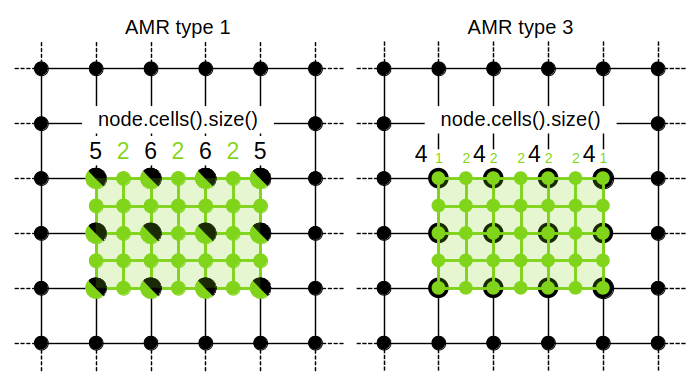
For Cartesian meshes, AMR type 3 is also available and introduces a new API. The user marks cells to refine, and then Arcane handles determining regular patches as well as overlap cells. The operation is more guided.
To use AMR type 3, the face numbering must be changed. Currently, the change is made during the first call to Arcane::ICartesianMesh::computeDirections(). Furthermore, patch numbering can be managed by the class Arcane::CartesianMeshNumberingMng.
The choice of AMR type to use is made in the dataset:
Table of Contents for this subsection:
 1.16.1